
 Autoflower Seeds
 Feminized Seeds
 New Releases
 USA Cannabis Seeds
 High THC Strains
 High Yield Cannabis Strains
 Precision F1 Hybrids
 Washing Strains
 Cup Winning Cannabis Seeds
 Chill Out Cannabis Strains
 Amsterdam Cannabis Seeds Classics
 Best Taste & Aroma Cannabis Seeds
 Regular Seeds
 Merchandise
 Merchandise
 Blog
Blog Contact Us
 Wholesale Login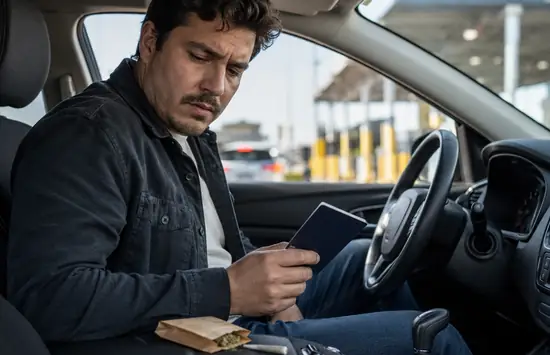
Cannabis at US Borders: Crossing From Canada and Mexico With Weed
You can buy a pre-roll legally in Seattle, drive twenty minutes north, and turn into a federal criminal the second your tires touch the line. That is the strange truth about cannabis at the US border. State legalization stops at the edge of the map. The border belongs to the federal government, and the federal government still treats weed like it is 1985.
Here is what actually happens when you bring cannabis to a US port of entry, why hauling it across from Canada or Mexico is a worse idea than ever, and what to do instead.
Is it legal to bring weed across the US border?
No. Not from Canada, not from Mexico, not even between two states that have both legalized it.
There is a wrinkle worth knowing. In April 2026 the Justice Department shifted two narrow categories, FDA-approved marijuana medicines and cannabis sold under a qualifying state medical license, into Schedule III. Everything else, including all recreational weed, stayed in Schedule I, the same federal tier as heroin, with a broader rescheduling hearing not set to begin until the end of June 2026. For a traveler that distinction barely matters. The dispensary flower in your bag is still Schedule I, and even the newly rescheduled medical products cannot be carried across the border without federal authorization.
Customs and Border Protection runs every port of entry under federal law, and federal law beats state law every time the two collide. So a dispensary can be fully licensed while the customs booth a few miles away treats the same product as contraband. It does not matter where you bought it or where you are going. The border itself is federal ground, and at the booth that is the only law that counts.
What happens if border agents find your weed?
Nothing good, and it escalates fast depending on how much you are carrying and whether you tried to hide it. According to CBP, arriving at a US port of entry with marijuana can mean seizure, fines, arrest, and denied entry. Those outcomes are not theoretical. Agents apply them every day.
Roughly speaking, the consequences sort out like this:
US citizens usually face confiscation and a fine for small personal amounts, but concealment or larger quantities can push agents toward criminal charges.
Non-citizens have the most to lose. A single cannabis finding can get you ruled inadmissible, turned around at the booth, and flagged for every future crossing. In some cases even admitting to past use during questioning is enough to create a problem.
Lying to an officer makes all of it worse and is its own offence.
Remember that the booth is a search zone. Agents can go through your car, your bags, and your phone without the warrant they would need on a normal street. If your vehicle smells like weed, that smell alone can trigger a full secondary inspection. A forgotten gummy in a center console has ended plenty of trips, and a vape pen tucked in a jacket pocket counts just the same.
Air travel does not save you either. Several Canadian airports run US preclearance, which means you face CBP officers on Canadian soil before you ever board the plane. You are inside the US legal system the moment you step up to that desk, so the rules are identical to a land crossing. Whatever inadmissibility or record you pick up there can follow you for years.
Can you bring weed from Canada?
This is the question that trips up the most people, because Canada legalized recreational cannabis nationwide back in 2018. Surely a legal Canadian product can ride into a legal US state?
It cannot. The Canada Border Services Agency is blunt about it: taking cannabis across the border in any form is a serious criminal offence, even when it was bought legally and even when your destination has legalized it too. The rule covers flower, edibles, and oils, THC or CBD, with no exceptions for personal amounts.
So you end up with a substance that is legal to buy on one side, legal to buy on the other, and illegal in the few hundred feet of federal space in between. Canadians who simply work in their country's legal cannabis industry have also caught extra scrutiny at US crossings over the years. The smart move heading south is the boring one. Leave it in Canada.
What about crossing the Mexico border with weed?
The southern border tells a different story, and the numbers are the interesting part.
Marijuana seizures along the US-Mexico border have been sliding for years, and the cause is legalization itself. As more US states opened licensed markets, the incentive to haul Mexican weed north collapsed. Hard drugs like fentanyl, meth, and cocaine now dominate what gets intercepted, while cannabis keeps shrinking. Why risk a federal smuggling charge for a product sitting on a shelf in your own state.
The everyday-traveler angle is even more lopsided. An investigation into Border Patrol data found that of more than 5.8 million migrants stopped between 2022 and 2024, drugs were seized from only 249 of them, and marijuana made up over half of those cases. The same analysis pointed out that a regular person getting caught carrying harder drugs across the border is statistically rarer than dying from a bee sting. The trafficking that does move weight runs mostly through hidden compartments at official ports of entry, not in a hiker's backpack.
None of this makes any of it legal. It just means the old smuggling era is fading, and getting personally tangled in it is a uniquely bad trade in 2026. The cannabis that still does get intercepted tends to turn up in commercial loads moving between official crossings, not in the pockets of people walking up to the booth. The lone traveler with a personal stash is the easy catch, not the prize.
Why smuggling weed makes no sense anymore
Think about what you are actually putting on the table. A finished product worth a few dollars, weighed against a criminal record, a seized vehicle, a travel ban, or a night in federal custody. That math has never looked worse.
Barney's Farm has watched this whole landscape shift from the inside. We have been breeding cannabis genetics out of Amsterdam since 1986, back when moving seeds across a border really was an act of rebellion and the only way to spread good genetics around the planet. That outlaw era built the modern cannabis scene. It is also done. You no longer have to play smuggler to get world-class genetics, because legal home cultivation now exists across huge stretches of the US.
That is the upgrade. Where the law allows it, you grow your own and the border stops mattering at all. A strain like Critical Kush shows why that is realistic for almost anyone. It is a fast, mold-resistant indica that shrugs off beginner mistakes and finishes in roughly eight weeks. No customs booth, no concealed stash, no gamble. Just a plant in your own space producing exactly what you would have risked your record to carry.
Can you cross the border with cannabis seeds?
People ask this constantly, usually after a trip to Amsterdam or a legal shop abroad. The straight answer is that any cannabis material at a US port of entry is an invitation for problems, and seeds are no exception. CBP can and does seize them, and a customs booth is the last place anyone should test a legal gray area.
There is a cleaner route. Order from a source that ships domestically where you live and skip the international line entirely. Our US catalog runs out of a distribution center inside the country for this exact reason. A classic like Pineapple Chunk, a hardy, high-yield favorite that beginners can actually finish, can land on your doorstep without anyone crossing a border to make it happen.
Genetics travel fine through legal channels now. The only job left to you is to put them in soil where you are allowed to. Check your own state's home-grow rules first, since plant counts and indoor-versus-outdoor limits vary, then order accordingly and keep the whole thing inside one set of laws.
The bottom line
Cannabis at the US border gets simple once you stop hunting for a loophole. Federal law treats it as illegal no matter what your state or your neighbor country says, and the people who get burned are almost always regular travelers who assumed legal-here meant legal-everywhere.
Leave your stash at home. If you want the good stuff waiting on the other side, buy it legally once you arrive, or better still, grow it yourself where the law lets you. The plant has finally outgrown the need to be smuggled. Let it.
Barney's Farm has been developing premium cannabis genetics since the 1980s, with over 40 Cannabis Cup wins. Explore our full cannabis seed catalog and find more Amsterdam classics, USA-bred hybrids, and award-winning strains.