
 Autoflower Seeds
 Feminized Seeds
 New Releases
 USA Cannabis Seeds
 High THC Strains
 High Yield Cannabis Strains
 Precision F1 Hybrids
 Washing Strains
 Cup Winning Cannabis Seeds
 Chill Out Cannabis Strains
 Amsterdam Cannabis Seeds Classics
 Best Taste & Aroma Cannabis Seeds
 Regular Seeds
 Merchandise
 Merchandise
 Blog
Blog Contact Us
 Wholesale Login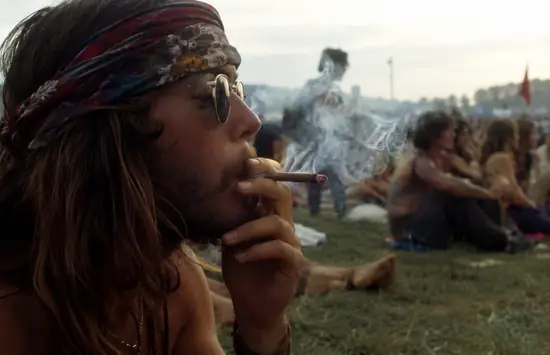
Cannabis at Woodstock 1969: How a Music Festival Mainstreamed American Weed
In August 1969, a New York dairy farm became the loudest argument for cannabis America had ever made. No legislation, no celebrity endorsement, no slick marketing campaign. Just a sea of bodies, a stack of amps, and clouds of smoke drifting over Max Yasgur's pasture for four straight days. Woodstock did not invent weed in America. What it did was drag the plant out of jazz clubs, beat poetry rooms, and college dorms, and put it on the front page of every newspaper in the country.
What the establishment had spent thirty years calling reefer madness was now visibly being smoked by half a million of their kids while Jimi Hendrix played the national anthem. The image was impossible to walk back.
Why is Woodstock 1969 famous for cannabis culture?
Woodstock was sold as “An Aquarian Exposition: 3 Days of Peace & Music,” but the cannabis part was never a secret. The festival pulled more than 460,000 people to Bethel, New York, between August 15 and 18, 1969. The fences came down on day one and ticketing collapsed, which meant the whole thing became a free, leaderless gathering of people who happened to share two things: a taste for loud guitars and a working knowledge of rolling papers.
Time magazine sent reporters on the ground and did not bury the lede. Their dispatch noted that at least 90 percent of those present at the festival were smoking marijuana. Joints moved hand to hand through the crowd. Strangers shared bowls. A homemade sign reading “Have a Marijuana” hung over a grass hut on day three. Nobody hid anything because there were too few cops and too many smokers for the math of prohibition to work.
This was the moment cannabis stopped being a subculture and started being a generation.
How did weed actually spread through the Woodstock crowd?
The mechanics matter. The festival ran on a kind of accidental commune economics. People showed up with what they had and shared. Food ran out, water ran out, the official caterer Food for Love jacked prices and got its stand burned down. What did not run out was weed, because almost everyone brought some.
By Saturday afternoon the music was running hours behind schedule, the rain had turned the field into a brown slurry, and the crowd had figured out that the only way through was together. Passing a joint to a soaked stranger five feet away was the smallest possible gesture of solidarity, and it happened roughly a million times that weekend.
The stage announcement everyone misremembers as Wavy Gravy warning about the brown acid was actually production manager Chip Monck telling the crowd “the brown acid that is circulating around us is not specifically too good.” Cannabis got no such warning, because nobody felt the need to issue one. That distinction tells you everything about how the festival's organizers and the crowd itself thought about the plant. Weed was background radiation. It was assumed.
What strains were Americans smoking at Woodstock in 1969?
The weed at Woodstock had almost nothing in common with what you would buy at a Los Angeles dispensary today. According to DEA testing data, cannabis at the 1969 festival typically contained around 1 percent THC, while modern flower averages 15 percent or higher. People at Yasgur's farm were lighting up what would now be classified as legal hemp.
The supply was almost entirely imported landrace material. Mexican Sativas dominated the East Coast in 1969, with Acapulco Gold sitting at the top of the food chain. The strain got its name from the bright gold buds laced with reddish-brown pistils, and its reputation came from a clean, head-forward high that suited a long Grateful Dead jam or a Joni Mitchell ballad equally well. Colombian Gold, Panama Red, and Thai sticks rounded out the rotation. Domestic indoor cultivation barely existed because nobody had a reason to invent it yet.
Barney's Farm carries Acapulco Gold as a regular seed line in the US catalog for exactly that reason. That genetic lineage built American cannabis culture before Schedule I tried to erase it, and preserving these Mexican landraces is one of the few ways the actual taste of 1969 still survives. Modern hybrids owe their flavor profiles to plants like this one, and growing the original puts you closer to what the Woodstock crowd was passing around than anything else on the market.
How Woodstock pushed cannabis into the American mainstream
The federal government had been at war with the plant since the Marihuana Tax Act of 1937, drafted by Federal Bureau of Narcotics chief Harry Anslinger and pushed through Congress on a wave of racially loaded propaganda. By the late sixties, the Supreme Court had struck the act down in Leary v. United States, and Richard Nixon was about to replace it with the Controlled Substances Act of 1970, which parked cannabis in Schedule I alongside heroin.
Woodstock landed right between those two pieces of legislation. The timing did most of the work. When Gallup ran its first national poll on cannabis legalization in 1969, only 12 percent of Americans said the drug should be legal. Most of the country had no personal contact with the plant. Their information came from Reefer Madness and the nightly news.
Then half a million kids showed up on television smoking openly, and the next morning America had to reconcile what they had been told with what they had just seen. The kids did not look like criminals. They looked like their neighbors' children, which is what they were. That contradiction did not resolve itself overnight. It took decades. Current Gallup polling sits at roughly seven in ten Americans in favor of legalization, a near six-fold increase from where the country stood the year of the festival.
Why the cannabis counterculture of the 1960s still matters
The hippie cannabis movement gets reduced to flower crowns and peace signs in most retellings, which sells it short. The 1960s counterculture gave the plant political weight. Smoking weed at Woodstock carried meaning that smoking weed at a fraternity kegger did not. The hippie cannabis movement tied the plant to opposition to the Vietnam War, civil rights, women's liberation, and a refusal to accept that authority got to decide what was harmful and what was not.
Dr. Lester Grinspoon, a Harvard psychiatry professor, started researching cannabis in the mid-sixties expecting to confirm the government's position that the drug was dangerous. The research changed his mind so completely that he spent the rest of his career arguing the opposite, publishing Marihuana Reconsidered in 1971 and becoming one of the loudest scientific voices for legalization. Barney's Farm honored him by naming the Dr Grinspoon strain after him, a 100 percent heirloom Sativa with the kind of long-flowering, lanky structure that pure landrace genetics produce when they have not been hybridized into oblivion. The strain exists because the man's work mattered, and the work mattered because Woodstock had already shown America what the stakes were.
The cultural shift Woodstock kicked off ran on a simple proposition. If this many people smoked weed, were happy, and did not turn into criminals, then the official story was a lie. Once that thought took hold, the rest was a matter of time.
From Yasgur's farm to legal dispensaries
The history of weed in America has a few clean inflection points, and Woodstock is one of them. The festival did not legalize cannabis. It made cannabis impossible to ignore.
Forty-three years later, Colorado and Washington became the first states to legalize recreational use. Recreational cannabis is now legal in well over twenty states, medical programs run in most of the rest, and the Drug Enforcement Administration is in the middle of a years-long fight over whether to reschedule the plant. None of that happens without the slow leak in the dam that started in August 1969.
The Woodstock generation grew up. They voted. Their kids voted. And the country that once polled at 12 percent now polls at 70.
That is what a music festival did. It put weed in front of a camera and told America to take a good look. America did. It took fifty-six years to fully come around, but the answer was always going to be yes.
Barney's Farm has been developing premium cannabis genetics since the 1980s, with over 40 Cannabis Cup wins. Explore our full cannabis seed catalog and find strains bred for every climate and skill level.