
 Autoflower Seeds
 Feminized Seeds
 New Releases
 USA Cannabis Seeds
 High THC Strains
 High Yield Cannabis Strains
 Precision F1 Hybrids
 Washing Strains
 Cup Winning Cannabis Seeds
 Chill Out Cannabis Strains
 Amsterdam Cannabis Seeds Classics
 Best Taste & Aroma Cannabis Seeds
 Regular Seeds
 Merchandise
 Merchandise
 Blog
Blog Contact Us
 Wholesale Login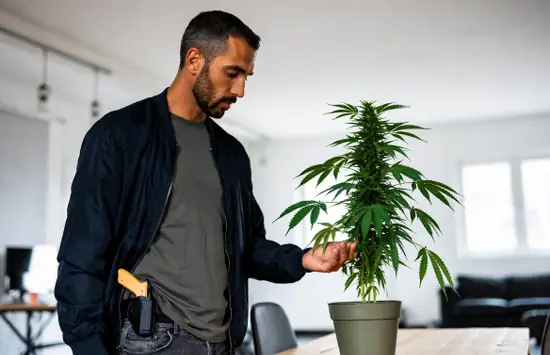
Cannabis and Concealed Carry Permits: Why It’s Different From Owning a Gun
You popped a pack of Barney’s Farm seeds, babied them through a grow, and ended up with a jar of something you’re proud of. You also carry. Both are legal where you live, and both are just part of how you run your own life. Then you walk into a gun shop, get handed a federal form, and the two halves of your world are suddenly on a collision course. This is one of the strangest standoffs in American law, and plenty of people walk right into it without knowing the ground is wired.
Most folks fold two questions into one. Can I own a gun, and can I carry one in public. They feel identical. They run on completely separate legal systems, and cannabis lands on each one in a different spot. If you smoke, grow, carry, or do all three, the gap between those two systems is exactly where people get hurt.
Two systems, two rulebooks
Buying and owning a firearm is a federal matter. Buy from a licensed dealer and you fill out ATF Form 4473, then pass a federal background check before anything leaves the store. That process answers to Washington and nobody else. Your state legislature does not get a vote in it.
A concealed carry permit runs on a separate track. Your state issues it, and a sheriff, a state police bureau, or some county office decides who qualifies under rules that change the second you cross a state line. So a cannabis user stands in front of two different gates with two different gatekeepers. Clearing one tells you nothing about the other, and that single fact explains most of the confusion around weed and gun permits.
The federal form that ruins the mood
Form 4473 asks, in blunt terms, whether you are an unlawful user of or addicted to marijuana or any other controlled substance. For years the form carried a warning that marijuana stays illegal under federal law no matter what your state legalized, medical card or not.
The root of all this sits in two old federal laws. The Controlled Substances Act sets marijuana’s schedule, and a separate piece of the Gun Control Act, 18 U.S.C. 922(g)(3), makes it a crime for any unlawful user of a controlled substance to possess a firearm. Nothing in that language carves out a medical patient or a weekend smoker in a legal state. As far as the statute reads, if the federal government still calls your cannabis illegal, you become a prohibited person the moment you light up.
Answer yes on the form and the dealer denies you on the spot. No discretion, no appeal at the counter, the sale just dies. Answer no while you actually use, and you have made a false statement on a federal record. That is a felony carrying years in prison and a fine that can climb into six figures. The ATF has held since at least 2011 that anyone using marijuana counts as an unlawful user, and a medical card has been treated as proof of exactly that.
Here is the catch that snares honest people. Prosecutions of ordinary users have historically been uncommon, so the question starts to feel like a formality you can shrug off. The exposure does not vanish because enforcement is patchy. A self-defense shooting, a traffic stop that goes sideways, or any moment that drops your paperwork under a microscope can turn a form you signed years ago into a fresh charge. You do not get to choose when somebody decides to read it closely.
Your permit lives somewhere else entirely
Here the map fractures. Carry rules are written state by state, and they do not agree with one another. Virginia treats medical cannabis patients as ineligible for a carry permit. Mississippi went the opposite direction and wrote protection straight into its medical marijuana statute, barring denial of gun rights based solely on someone’s status as a registered patient. Florida lets medical patients carry under state law even while the federal purchase question hangs over their heads. In Honolulu, police have run permit applicants against the medical marijuana database and turned away the ones it flagged.
This is the same patchwork that gave us shall-issue and may-issue permit regimes in the first place, so it should surprise nobody that cannabis gets handled inconsistently from one state to the next. The honest answer to whether you can hold a carry permit with a medical card is that it depends on where you are standing when you ask. The federal layer governs whether you can buy the gun. The state layer governs whether you can carry it. You can fail one and pass the other, which is how a person ends up legally carrying a firearm they could not have legally bought that same week.
2026 shook the board
The ground is moving fast right now, which is why old advice on this subject rots quickly. In April 2026 the DEA’s rescheduling order took effect and moved FDA-approved cannabis products and state-licensed medical marijuana to Schedule III. Recreational use stayed parked in Schedule I, and a broader hearing on everything else was set to open later in the year. You can read the government’s own notice in the Federal Register instead of trusting anyone’s paraphrase, including this one.
For an everyday consumer, that change does less than the headlines suggest. If your use is recreational, federal law still treats you the way it always has. The ATF then posted a draft revision of Form 4473 that drops state-authorized medical cannabis from the disqualifying language and points the prohibition at recreational use instead. That draft is not law yet. It sat in a public comment window, and until a final version actually reaches gun counters, the old form and its felony trap still apply to everyone signing it.
The bigger domino is at the Supreme Court. In United States v. Hemani, the justices are weighing whether the federal ban on gun possession by drug users survives the Second Amendment when it is aimed at a marijuana user who kept a pistol at home for protection. During March 2026 oral arguments, much of the bench sounded skeptical of the government’s position, pressing on how vague the phrase unlawful user really is and whether a casual consumer counts as dangerous at all. The National Constitution Center keeps a clean rundown of how the case got there. A ruling is expected by the end of the term, and it could redraw this entire map.
What Barney’s Farm would tell you over a session
Barney’s Farm has spent decades putting serious genetics in growers’ hands. Pineapple Express earned its legend as a tropical sativa, and Gorilla Zkittlez crosses Gorilla Glue with Zkittlez into one of the heaviest indica-leaning hybrids in the catalogue. That history comes with a point of view. The cultivation community has always lived in the space between what the rulebook says and what actually makes sense, and the people who thrive there are the ones who learn the terrain cold rather than pretend it is simpler than it is.
So treat this the way you treat a grow. Watch the details and do not cut a corner that comes back to bite you. Never handle a firearm while you are high, the same way you would never drive on it, because impairment plus a loaded weapon is a genuinely bad combination and no clever legal argument fixes a tragedy after the fact. Keep your records straight. Learn your own state’s stance before you apply for anything. Decide with clear eyes which card you actually want sitting in your wallet, because plenty of people in legal states have quietly picked one lane rather than gamble on the overlap.
The culture around cannabis was built by people who refused to accept that their choices made them criminals, and that stubbornness is worth keeping. So is your freedom. The fastest way to lose it is to treat a federal form like a box-ticking chore.
The short version
Owning a gun and carrying one are two different legal questions, and cannabis answers them in two different places. Federal law controls the purchase through Form 4473, where marijuana use can still cost you the sale or land you in real trouble. State law controls the carry permit, and those rules swing hard depending on your address. The whole structure is shifting through 2026, but nothing is settled until the Supreme Court rules and the new forms actually land on counters.
None of this is legal advice, and your situation deserves a real attorney in your state if money or freedom is on the line. Know the rules, respect the hardware, and grow good weed. The rest is just paying attention.
Barney’s Farm has been developing premium cannabis genetics since 1986, with more than 40 Cannabis Cup wins. Explore our full cannabis seed catalog and find the genetics that fit how you actually medicate.