Can You Test Positive for Weed From Secondhand Smoke? What the Research Says
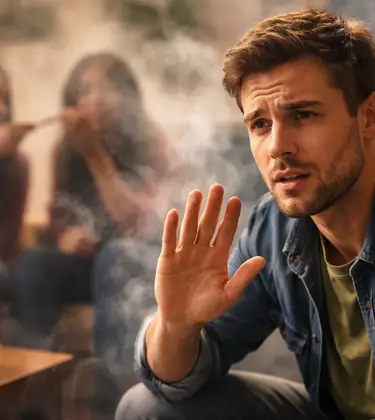
You stayed clean, did everything right, and still got flagged on a drug test. Now someone’s asking questions, and your only defense is, “I was just in the room.” Sounds flimsy. But is it true?
With cannabis legal in more than half the country and THC potency climbing every year, this scenario comes up more than you’d think. Whether you’re prepping for a pre-employment screen or just trying to understand what secondhand exposure actually does to your body, the answer matters. So let’s get into what the science says about secondhand marijuana smoke and drug tests.
Can You Actually Test Positive for Pot From Secondhand Smoke?
Short answer: technically yes, but you’d need to try pretty hard. Or more accurately, you’d need to sit in a sealed room full of smoke for a solid chunk of time without cracking a window.
A landmark study from Johns Hopkins University placed nonsmokers in a small, sealed chamber with six active smokers who burned through ten high-potency joints over the course of an hour. With no ventilation at all, every single nonsmoker showed detectable THC in their blood and urine. One even tested above the 50 ng/mL cutoff used in the Federal Workplace Drug Testing Program.
But here’s the critical detail: when the researchers ran the same experiment with the ventilation fans turned on, none of the nonsmokers tested positive. Not one. The difference between a failed test and a clean result came down to whether someone opened a vent.
That finding alone tells you a lot about how realistic this risk is in everyday life. Unless you’re intentionally hotboxing a closet with zero airflow, the conditions required to absorb enough THC through passive exposure are extreme and completely obvious to anyone involved.
What Does the Research Say About Secondhand Marijuana Smoke and Drug Tests?
The Johns Hopkins study isn’t the only one to look at this. A companion paper published in the Journal of Analytical Toxicology examined the urine results from the same experiment in more detail. At the standard 50 ng/mL screening cutoff, only one nonsmoker out of six produced a single positive result under the most extreme unventilated conditions. When researchers dropped the threshold to 20 ng/mL (a cutoff some commercial labs use), several nonsmokers tested positive, but only in the hours immediately following exposure.
That timing piece is worth underlining. Even in a worst-case hotbox scenario, detectable THC metabolites didn’t linger. They showed up fast and cleared fast. By the time a day had passed, levels were back to baseline for all participants.
A separate real-world study looked at law enforcement officers providing security at outdoor concerts where cannabis smoke was heavy in the air. Despite spending entire shifts surrounded by smoke, trace amounts of THC metabolites in the officers’ urine were well below any standard workplace testing threshold. None of them would have failed a drug screen.
Can a Contact High Actually Make You Fail a Drug Test?
Contact highs are real, but they’re a lot less dramatic than pop culture makes them out to be. The Johns Hopkins researchers found that nonsmokers in the unventilated chamber reported feeling mildly intoxicated and showed slight dips in cognitive performance. A few said they felt pleasant but a little foggy.
In the ventilated session? The only effect nonsmokers reported was hunger, and the study was conducted around lunchtime, so take that one with a grain of salt.
The distinction matters because people worry that a contact high automatically means a positive drug test. For most real-world situations, it doesn’t. You’d have to be in a cramped, sealed space with active smokers for an extended period. Walking past someone on a sidewalk, sitting in a park, or spending time in a well-ventilated apartment where someone else is smoking is extremely unlikely to produce enough THC absorption to trip a standard drug test.
At Barney’s Farm, we’ve spent over 30 years breeding strains and studying how cannabinoids behave from seed to smoke. One thing we know well: THC is sticky, potent, and efficient when delivered directly. But in secondhand smoke, the concentrations reaching a bystander’s lungs are roughly 100 times lower than what the actual smoker inhales. That’s a massive gap when you’re talking about crossing a testing threshold.
Feeling lost on how to start? Try taking our quiz!
Start a QuizHow Long Does Secondhand Weed Smoke Stay in Your System?
This depends on the type of test and the intensity of exposure, but for passive secondhand exposure, the window is surprisingly short.
In the Johns Hopkins study, THC appeared in nonsmokers’ blood immediately after the unventilated session and was detectable for up to three hours. Urine metabolites lasted slightly longer but fell below standard cutoffs within a day. Compare that to active smokers, where THC metabolites can linger in urine for days, weeks, or even months depending on frequency of use and body composition. Your body processes trace secondhand exposure quickly because the amount absorbed is so small.
Hair tests deserve a separate mention. Research has shown that even brief secondhand smoke exposure in an enclosed room can deposit enough THC onto hair to produce a positive hair follicle result, even when the same participants’ urine tests came back clean. Hair testing is sensitive enough to pick up environmental contamination, which is one reason many experts and advocacy groups have questioned its reliability for distinguishing actual drug use from incidental contact.
The unexamined day is a wasted opportunity. Reflect on what you did, what you learned, and how you can improve.
John Dewey
How Do Different Drug Tests Handle Secondhand Exposure?
Not all tests are created equal, and understanding how each one works can take some of the stress out of this question.
Urine tests are the most common, especially for employment screening. They use a 50 ng/mL cutoff for THC metabolites under federal guidelines. At that threshold, secondhand exposure almost never triggers a positive. You’d need extreme, prolonged exposure in a sealed environment to get there.
Blood tests detect active THC in the bloodstream and are typically used in legal or roadside contexts. THC from secondhand smoke clears the blood within a few hours, so unless you’re tested immediately after heavy passive exposure, blood tests are unlikely to be an issue.
Saliva tests look for recent THC presence and are gaining popularity for workplace testing. Secondhand exposure can deposit trace THC in the mouth, but levels typically fall well below the screening thresholds used by certified labs.
Hair follicle tests have the longest detection window (up to 90 days), but as noted above, they can pick up environmental contamination from simply being near smoke. This makes them the most likely to flag passive exposure, though many testing programs factor this limitation into their interpretation of results.
How to Minimize Your Risk Before a Drug Test
If you’ve got a test coming up and you’ve been around cannabis smoke, a few practical steps can help.
Ventilation is everything. The research is consistent on this point. Open air, fans, and cross-breezes reduce THC absorption to negligible levels. If you’re in a space where someone is smoking, crack a window or step outside. That single variable was the deciding factor in every controlled study on this topic.
Distance matters. Even a few feet between you and the smoke source makes a significant difference in how much THC you’re breathing in. You don’t have to leave the party. Just don’t plant yourself in the center of the cipher.
Timing counts. Secondhand THC clears the body fast. If possible, put at least 24 to 48 hours between any passive exposure and your test. That’s usually more than enough time for trace metabolites to drop below any standard cutoff.
Know the potency. Modern cannabis is substantially stronger than what was around even a decade ago. At Barney’s Farm, we’ve watched the industry evolve from strains testing in the single digits to varieties regularly exceeding 25% THC. Higher-potency cannabis produces more THC-rich smoke, which means secondhand exposure in enclosed spaces carries more weight than it used to. Knowing what’s being smoked around you gives you a better sense of the actual risk.
The Bottom Line
Can secondhand smoke make you fail a drug test? Under lab conditions designed to mimic the worst possible scenario, yes. In real life? It’s extremely unlikely.
The CDC acknowledges that secondhand cannabis smoke contains THC and can produce psychoactive effects in bystanders. But the gap between “detectable” and “enough to fail a workplace drug test” is wide. Standard testing cutoffs exist specifically to filter out incidental exposure and prevent false positives from passive contact.
Drug testing technology has gotten better, but the fundamental biology hasn’t changed. Your body handles trace secondhand THC the same way it handles trace anything: quickly and efficiently. The people who should be concerned are people spending extended time in unventilated spaces saturated with smoke. For everyone else, the data is clear.
If you’re a cannabis enthusiast who’s mindful of the people around you, or someone who just happens to be in the vicinity, the takeaway is straightforward: stay in ventilated spaces, keep some distance when possible, and don’t lose sleep over walking past a joint at a concert. The research says you’ll be fine.
Barney's Farm has been developing premium cannabis genetics since the 1980s, with over 40 Cannabis Cup wins. Explore our full seed catalog and find strains bred for every climate and skill level.