Can You Get a DUI on a Boat for Smoking Weed?
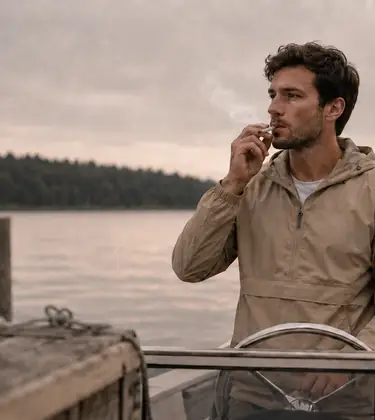
The Coast Guard can board your boat without any suspicion at all. No probable cause, no reasonable articulable suspicion, nothing. The Supreme Court has upheld that, and in the same opinion pointed out that stopping a car the same way would violate the Fourth Amendment.
That is the starting point for everything else here, and most people on the water have no idea.
This guide covers the federal boating law that covers drugs, why the water you are floating on decides which rules apply, what the states do, and why there is no legal THC limit for boats.
Yes, and the Coast Guard needs no reason to check
Yes, and it is easier to get than a driving equivalent. There is no THC number to be under. The federal standard for drugs is an observation test, the boarding rules are far looser than on a road, and on federal water your state's legalization does not travel with you.
The federal law
Operating a vessel under the influence of alcohol or a dangerous drug is a federal offense under 46 U.S.C. 2302, and the definition of dangerous drug points straight at the Controlled Substances Act. Cannabis is a controlled substance, so it is inside the statute.
The penalty in the statute reads as a civil penalty of up to $5,000 or a class A misdemeanor. The civil figure has been inflation-adjusted upward and now sits at $9,624 for operating a vessel while under the influence of alcohol or a dangerous drug.
The standard itself is where cannabis differs from alcohol. The regulation sets 0.08 percent blood alcohol for recreational vessels and 0.04 for everything else, then adds a third route that applies to any intoxicant: an individual is under the influence when the effect of the intoxicants consumed on the person's manner, disposition, speech, muscular movement, general appearance or behavior is apparent by observation.
No number, no device, no threshold. An officer's observation is the test. Refusing a test when an officer has reasonable cause is admissible against you and creates a presumption of impairment. And the Coast Guard can terminate your voyage outright, sending the boat back to shore, if it judges continued operation unsafe.
Boarding without suspicion
This is the part that genuinely surprises people. Federal law authorizes the Coast Guard to go on board any vessel subject to the jurisdiction of the United States at any time, address inquiries, examine documents, and search the vessel, using all necessary force to compel compliance.
The Supreme Court upheld that in 1983, holding that the first Congress clearly authorized suspicionless boarding of vessels by government officers. The same opinion says plainly that if customs officers had stopped an automobile on a public highway the same way, the stop would have run afoul of the Fourth Amendment because there was no articulable suspicion.
Boat, fine. Car, unconstitutional. Same officers, same absence of suspicion.
Feeling lost on how to start? Try taking our quiz!
Start a QuizWhich water you are on decides everything
Here is the trap that catches state-legal users, and almost nobody explains it. Federal jurisdiction on the water is broader than the ocean. It covers navigable waters, including inland non-tidal water that has been used or is capable of use as a highway for interstate commerce, and it covers waters on land owned or controlled by the United States.
That pulls in an enormous amount of recreational water. National Park Service units are the clearest case. Inside a park unit, possession alone is the offense, and the Park Service's own vessel rule states that its provisions also apply to an operator who is or has been legally entitled to use alcohol or drugs.
Read that twice if you have a medical card.
The Park Service says it out loud in legal states. Rocky Mountain National Park's own guidance states that while Colorado provides for regulated possession and use, cannabis remains illegal under federal law and is enforced within the park. Bering Land Bridge in Alaska says the same thing.
A park citation is not trivial either. Charges under the possession rule carry up to six months and fines up to $5,000.
Army Corps of Engineers lakes work differently, and this is a nuance most articles get wrong. The Corps runs more than 400 lake and river projects across 43 states, and its public use rules contain no standalone drug prohibition, deferring instead to state and local law. So a Corps reservoir in a legal state is a genuinely different proposition from a national recreation area.
The unexamined day is a wasted opportunity. Reflect on what you did, what you learned, and how you can improve.
John Dewey
What the states do
All fifty states and the District of Columbia prohibit boating under the influence of alcohol and controlled substances, and in most of them operating a boat is treated as implied consent to testing.
A few states have gone further. Washington sets a per se limit on the water of a THC concentration of 5.00 or higher shown by analysis of the person's blood, alongside 0.08 for alcohol, with the offense running from misdemeanor to gross misdemeanor.
There is also a difference between drinking and smoking that catches passengers out. Open container laws generally do not extend to boats, which is why passengers can legally drink on the water in many states. That has no cannabis equivalent. Where possession is illegal, it is illegal for the passenger holding it, not just the person steering.
The enforcement picture
The Coast Guard's 2024 statistics recorded 556 boating deaths across 3,887 incidents. Alcohol was the leading known contributing factor in fatal incidents, listed in 20 percent of deaths where the primary cause was known, accounting for 244 incidents and 92 deaths.
Drug use appears in the same table at 7 incidents and 5 deaths. Do not read that as evidence that drugs are not a problem on the water. Read it as evidence that nobody is measuring. There is no roadside-equivalent test for cannabis impairment, so it largely does not appear in the data.
Enforcement effort is real though. The national Operation Dry Water weekend in 2025 involved 451 agencies and over 7,000 officers, contacting nearly 88,000 vessels and issuing 501 boating-under-the-influence charges.
Why there is no legal THC limit
The same reason there is no reliable one on land. Federal transportation research has concluded that blood THC level does not appear to be an accurate and reliable predictor of impairment, that peak THC can occur when low impairment is measured, and that high impairment can be measured when THC level is low.
So the federal boating rule falls back on observation, and observation on a boat is complicated by an environment that impairs everyone.
The Coast Guard's own guidance is worth reading on this. Motion, vibration, engine noise, sun, wind and spray accelerate impairment, and these stressors cause fatigue that makes coordination, judgment and reaction time decline faster. Boating educators call the baseline effect boater's hypnosis, and describe hours of exposure to those stressors as slowing reaction time almost as much as being legally drunk.
Whatever you take onto a boat, you are taking it on top of that.
The bit a grower can actually plan around
We are a seed company and we are not going to pretend otherwise, so here is the narrow thing that is true.
The variable you can control is duration, and it is a genetics and format question. Inhaled cannabis peaks in minutes and fades over two to three hours for most people. An edible eaten on the dock can still be working when you are docking six hours later, in the dark, tired, sunburned and dehydrated.
If the day involves a boat, the honest planning is that consumption happens after the engine is off and the lines are tied, not before. That means picking plants for the evening rather than the afternoon, and knowing exactly how long yours lasts, which is something you only learn by growing the same thing repeatedly.
Moby Dick Auto is a 70% sativa at 23% THC, Moby Dick crossed into our Super Auto line, 65 to 70 days from seed at 90 to 110 cm, sour lemon and haze over pine with an uplifting, chatty effect. Sour Diesel Auto is a 60% sativa at 24%, the same 65 to 70 day window at 90 to 120 cm, citrus and diesel with a creative, energetic character.
Both are moderate by modern standards, which is the point. Four decades of breeding has taught us that the strongest thing in the catalog is rarely the right thing for a day with a schedule attached to it.
Different water, different rules
Operating a vessel under the influence of a controlled substance is a federal offense with a civil penalty now above $9,600, and the standard for drugs is an officer's observation because there is no THC threshold in the rule.
The Coast Guard can board any vessel with no suspicion whatsoever, which the Supreme Court has upheld while noting the same stop on a highway would be unconstitutional.
On National Park Service water, possession alone is an offense and the rules expressly apply to people legally entitled to use cannabis under state law. Corps of Engineers lakes defer to state law instead. All fifty states ban boating under the influence of drugs, and Washington sets a 5 nanogram per se limit on the water.
Barney's Farm has been developing premium cannabis genetics since the 1980s, with over 40 Cannabis Cup wins. Explore our full seed catalog and find strains bred for every climate and skill level.